
Table of Contents
This case study is based on a Pinion client using real production and financial data. Names and locations have been withheld for confidentiality.
Sometimes the biggest gains are already sitting inside the business
When farmers hear the word “benchmarking”, they often assume it is only useful for struggling businesses. But in reality, benchmarking can be even more valuable on farms that are already performing well – because it helps uncover opportunities that are otherwise easy to miss in day-to-day management.
That was exactly the case on a mixed livestock farm in the Eastern Cape. The business was already profitable, biologically efficient and well managed. Reproduction figures were strong, direct costs were controlled, and the farm was operating close to its grazing capacity. On the surface, there was very little that looked “wrong”.
But once the numbers were unpacked at enterprise level, benchmarking revealed something important. The boer goat enterprise was consistently outperforming the cattle enterprise on several key profitability and efficiency measures – despite making up only a very small part of the overall system. That finding raised a bigger strategic question: Was the farm’s natural resource base being used in the most profitable and resilient way possible?
A strong farming business formed the baseline
The farm operates under extensive conditions and runs a combination of:
- Beef cattle
- Boer goats
- A cash cropping component under irrigation
The reporting year received approximately 450mm of rainfall, slightly below the long-term average. Even under those conditions, the business delivered strong results. With a total stocking rate of approximately 1,400 LSU and grazing capacity already close to fully utilised, this was not a case of unused capacity waiting to be filled. In fact, benchmarking confirmed that management quality across the business was already high.
The cattle herd showed excellent reproductive performance:
- Conception rate: 91%
- Weaning percentage: 88%
Under extensive conditions, figures like these generally indicate:
- Sound nutrition
- Good breeding management
- Strong herd control
- Disciplined overall management
The business also showed:
- Healthy gross margins
- Strong labour efficiency
- Controlled direct costs
- Solid net farm income
That strong foundation is exactly what made the next discovery so significant.
The benchmark revealed that goats were “punching above their weight”
At the time of the analysis, approximately:
- 94% of grazing capacity was allocated to cattle
- Only 6% was allocated to boer goats
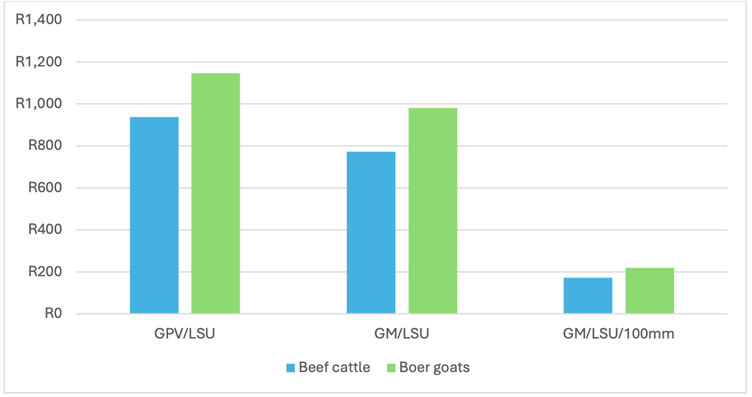
That split is fairly common in many Eastern Cape and Karoo systems. However, once enterprise-level benchmarking was done, a very different picture emerged. Across multiple measurements, the boer goat enterprise consistently outperformed the cattle enterprise.
The goats generated stronger:
- Gross production value (GPV)
- Gross margins (GM)
- Gross margin per LSU
- Gross margin per hectare
- Gross margin per 100mm of rainfall
Importantly, the same pattern appeared across several different benchmarking methods, which strengthened confidence in the finding.
Per LSU:

Per hectare:
Per kg product:
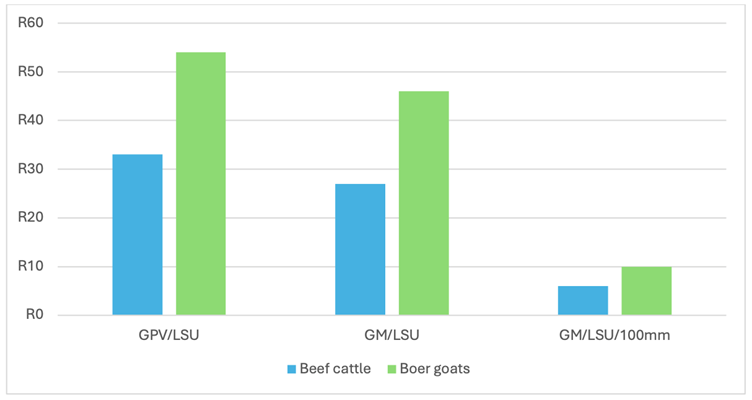
Taken together, the numbers all pointed in the same direction: the goat enterprise was extracting more value from the resources allocated to it.
Why this matters
Although goats occupied only a small share of the system, they were producing disproportionately strong returns. The table below helps explain why.
| Beef cattle | Boer goats | |
| Sales as % of enterprise GPV | 59% | 52% |
| GPV as % of total GPV | 64% | 7% |
| Direct costs as % of enterprise GPV | 18% | 14% |
| Gross margin as % of total GPV | 91% | 7% |
Gross production value (GPV) is the total value of production generated by an enterprise before direct costs are deducted. In a livestock enterprise, this includes the value of animals or products sold, together with changes in inventory value where relevant. Direct costs are the costs directly linked to running that specific enterprise and gross margin is what remains after those direct costs are deducted from GPV.
In simple terms:
- Sales as % of enterprise GPV shows how much of an enterprise’s production value came from sales during the year
- GPV as % of total GPV shows how much each enterprise contributed to the farm’s total production value
- Direct costs as % of enterprise GPV shows how much of that enterprise’s production value was used up by direct costs.
- Gross margin as % of total GPV shows how much each enterprise contributed to the farm’s total gross margin
Cattle still dominated total farm income because they occupied most of the grazing system. But the benchmark suggested that goats may actually have been under allocated relative to the value they were producing.
For us, that is a very important distinction. The issue was not that the cattle enterprise was weak. The issue was that the goat enterprise appeared exceptionally efficient relative to the grazing capacity allocated to it.
The biological reason behind the goat advantage
The opportunity was not only financial – it was ecological as well.
The benchmark highlighted an important biological reality of mixed veld systems:
- Cattle are grazers
- Goats are browsers
That difference becomes highly relevant in semi-arid environments where a large portion of the available feed resource exists above the grass layer.
Goats are able to utilize shrubs, woody species, bush encroachment, forbs and browse material. These are feed resources that cattle often underutilise.
As a result, mixed grazer-browser systems can often:
- Improve total veld utilisation
- Reduce selective grazing pressure
- Improve veld balance
- Increase drought resilience
- Spread production risk more effectively
This was one of the most important findings of the benchmark. On paper, the farm already appeared close to full grazing capacity. But benchmarking suggested the system may still have been underutilising part of its available feed resource – specifically browse. In other words, the opportunity was not necessarily about running more animals. It was about running a better mix of animals.
Scenario modelling explored what a different livestock mix could achieve
To test the possible upside, scenario modelling was done using an alternative livestock allocation.
The exercise explored what could happen if the enterprise mix shifted from and to:
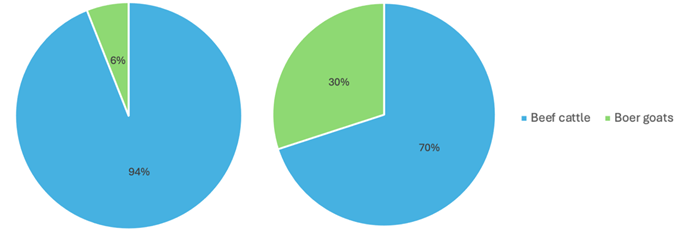
Importantly, this was not presented as a recommendation to suddenly replace cattle with goats overnight. It was simply a strategic modelling exercise designed to test how a larger browsing component might affect whole-farm performance.
What the numbers showed:
The current system runs:
- 1,416 total LSU
- 1,337 LSU cattle (94.4%)
- 79 LSU boer goats (5.6%)
Under the model:
- Beef cattle reduce to 992 LSU
- Boer goats increase to 425 LSU
This effectively replaces approximately 345 cattle LSU with 345 goat LSU.
The financial logic behind the model:
The benchmark showed:
On gross margin per LSU basis:
- Beef cattle generated approximately R4,676 (GM/LSU)
- Boer goats generated approximately R5,938 (GM/LSU)
On a net farm income per LSU basis:
- Beef cattle generated approximately R3,200 (NFI/LSU)
- Boer goats generated approximately R4,061 (NFI/LSU)
Once this difference was applied across the proposed LSU shift, the projected gain became meaningful.
The modelling estimated that:
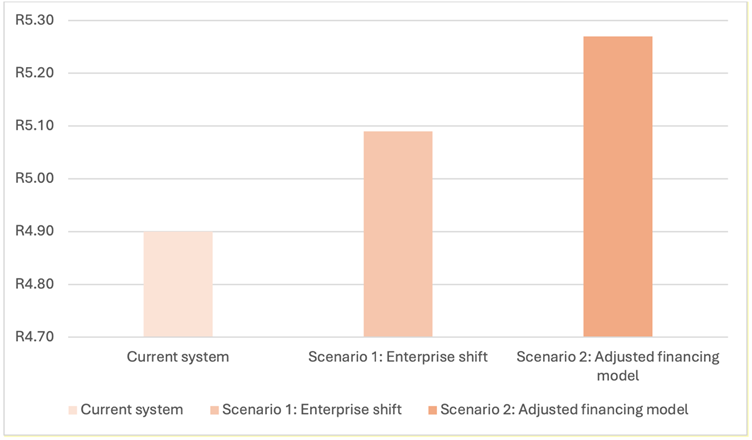
- Replacing 345 cattle LSU with goats could increase net farm income by approximately R392,000
- Assuming 90% of additional gross margin flowed through to the bottom line
There was also a financing benefit. Reducing cattle numbers could potentially release enough capital to reduce the farm’s overdraft by around 40%.
At an 11% interest rate, this could save approximately R165,000 per year in interest. After allowing for an additional R75,000 contingency for extra goat-related management costs.
The overall net farm income was projected to increase by approximately 10%, improving both profitability and cash flow. For a business that was already profitable, that is significant.
The transition would need to be phased
The model also highlighted the capital implications of such a shift. Selling 345 cattle units at approximately R18,000-R22,000 each could release around R6.9 million. However, purchasing approximately 2,300 commercial boer goat ewes at around R3,200 each would cost roughly R7.36 million. Additionally, infrastructure requirements could add another R1-3 million.
For that reason, the benchmark suggested that any transition would likely need to happen gradually over 3-5 years.
A phased approach would allow the farmer to:
- Breed up numbers internally
- Spread infrastructure costs
- Adjust management systems
- Evaluate performance as the goat enterprise expands
The value goes beyond profit alone
One of the most interesting outcomes of the benchmark was that the opportunity was not only about chasing a better margin.
A stronger browsing component could also potentially improve:
- Veld utilisation
- Bush management
- Drought resilience
- Enterprise diversification
- Risk reduction
Mixed enterprise systems are often more resilient because they spread exposure across:
- Different markets
- Different feed resources
- Different climate pressures
That creates strategic value beyond the financial calculations alone.
Projected change in whole-farm net farm income (NFI) under alternative livestock allocation scenarios
Goats are not “easy money”
The benchmark did not suggest that goats are automatically the better enterprise in every situation.
Profitable goat farming still depends heavily on:
- Good fencing
- Predator management
- Labour quality
- Breeding discipline
- Strong marketing systems
Poorly managed goat systems can become expensive very quickly. But in this case, the benchmark suggested the farm already had the management base required to seriously consider expansion.
What the benchmark really revealed
The main takeaway from this case study is not simply: “Replace cattle with goats”. The real lesson is that enterprise-level benchmarking can reveal hidden upside inside an already successful farming business.
Without detailed benchmarking, this client may never have realised:
- How efficiently the goat enterprise was performing
- How much value browse resources were contributing
- How enterprise allocation was affecting whole-farm profitability
- Where future gains may realistically come from
In this case, the opportunity appeared to lie in:
- Better browse utilisation
- Improved enterprise balance
- Stronger hectare efficiency
- Better capital allocation
And perhaps most importantly, the projected improvement did not rely on buying more land or dramatically expanding the business. It came from potentially using the same natural resources more effectively.
Conclusion
This case study highlights why benchmarking is such an important management tool.
The farm was not underperforming. In fact, it already had:
- Strong production figures
- Strong financial performance
- Good management systems
What benchmarking added was strategic clarity. It identified where the next gains might come from. The boer goat enterprise consistently delivered stronger returns on a per-hectare and per-LSU basis, while also offering ecological advantages through improved browse utilisation. That does not mean cattle should simply be replaced by goats. Infrastructure, labour, predator pressure, management capacity and market conditions still remain critical.
But the analysis strongly suggested that a better-balanced livestock mix could potentially unlock additional profit and resilience without relying on:
- More land
- More debt
- Major expansion
And that is ultimately the real value of benchmarking – sometimes the biggest opportunities are already sitting inside the business, they just have to be identified first.
That is exactly where Pinion can add value. We work with producers to unpack the numbers, interpret what they mean in the context of the whole farming business and guide practical decision-making step by step. Our benchmarking tool was created for exactly this purpose – to help farmers move beyond instinct alone, identify where the real opportunities lie and build a more profitable, resilient business with confidence.
Visit our website or contact info@pinionza.com for more information.