
In a world of increasing complexity — rising costs, evolving technology, and growing external pressure — the message from the 2026 Large Herds Conference was surprisingly simple:
The farms that succeed are not the ones doing more; they are the ones doing the right things consistently and doing them well.
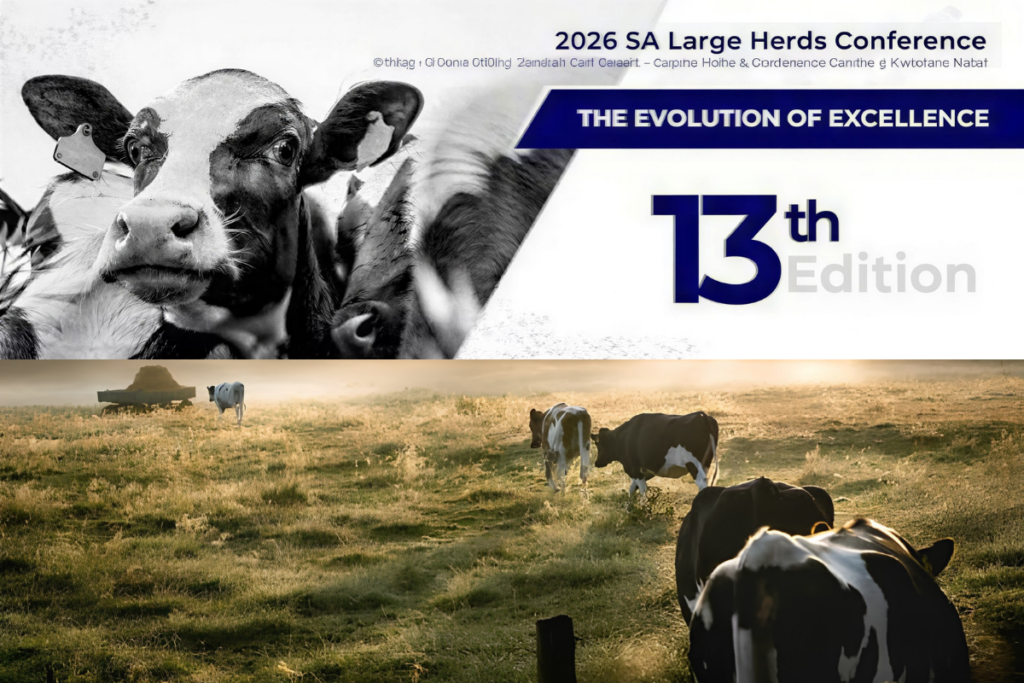
Held under the theme Evolution of Excellence, the conference brought together a wide range of perspectives, from global economic outlooks to soil health and calf rearing.
But across all sessions, a clear pattern emerged:
Success in dairy farming is not driven by one big idea, but by a number of small, well-executed decisions across the system.
Key takeaways
- Resilience comes from the whole system — soil, pasture, cows and people — not from isolated strengths.
- The biggest gains are usually already inside the existing operation, particularly calf rearing and soil health.
- Consistent execution by well-led people beats complexity and occasional high performance.
The environment is not getting easier
The business environment is changing fast, particularly through the rise of technology and AI. Opening the conference, Justin Cohen set that tone.
This was followed by Daniel Silke, who brought the discussion back to South Africa’s economic reality: a low-growth, high-cost environment where volatility is likely to persist. Important to note, this was not an entirely negative outlook. While the environment remains constrained, there were signs of improving stability and early “green shoots”, suggesting that progress is possible.
The implication for farmers is clear: the focus should not be on waiting for better conditions, but on building businesses that can perform under pressure.
Strong systems outperform quick fixes
From a practical farming perspective, Steve Moss reinforced the importance of system thinking.
High-performing farms are not built on isolated strengths, but on alignment across:
- soil
- pasture
- cows
- people
His message was simple but powerful. Resilience is built through the system, not through individual decisions.
“Every storm leaves a lesson behind. Strong systems turn challenges into lessons; weak systems turn them into losses.”
This idea was echoed in James Blignaut’s session, which reframed the methane conversation by emphasising the importance of understanding biological systems rather than reacting to external narratives.
Profitability is about resilience, not just performance
Shocks are not unexpected — they are inevitable. That was John Hudson’s starting point as he shifted the focus to the financial side of farming.
The difference between good and great businesses lies in their ability to:
- absorb pressure
- continue operating
- recover quickly
This requires strong financial discipline, appropriate debt structures, and sufficient reserves — not just strong performance in good years.
The biggest gains are often already on the farm
Across operational sessions, including contributions from Frans van Bohemen and Murray Bredin, a clear message emerged:
Many of the biggest opportunities are already within the existing system.
- Calf rearing, for example, was highlighted as a major long-term profit driver, with early-life management directly influencing lifetime performance.
- At the same time, efficiency gains in areas such as irrigation and power can often be achieved through better understanding and optimisation of existing systems.
Simplicity and consistency drive performance
Insights from international panel discussions reinforced a key principle: the most profitable systems are often the simplest.
“Focus on staff engagement and pasture harvest has led to profitability.”
Top-performing farms:
- follow a clear system
- execute it consistently
- avoid unnecessary complexity
“Consistency beats complexity.”
This was backed up by Justin King, who emphasised that success is not about occasional high performance, but about consistent execution over time.
People remain the biggest lever
While systems are critical, performance ultimately comes through people.
Sanet Grobler highlighted that underperformance is rarely just an individual issue. It is often linked to:
- lack of clarity
- skills gaps
- management approach
Improving performance therefore requires:
- clearer communication
- stronger leadership
- ongoing development of people
“What gets appreciated gets repeated. Performance problems are often system and leadership problems, not just people problems.”
Technology must serve the system
Technology, particularly AI, was a strong theme in sessions from Arthur Goldstuck and Jane Holliday.
While the opportunity is clear, the warning was equally strong:
- technology does not automatically deliver value
- it must fit the system and solve a real problem
Poorly applied, it adds complexity rather than efficiency, a common trap in modern farming systems.
The foundation remains unchanged
Despite advances in technology and management, two areas stood out as fundamental:
- soil health
- young stock management
As highlighted by Fiona Brennan, soil remains a living system that underpins productivity, resilience, and long-term sustainability.
Similarly, calf rearing represents one of the most significant opportunities to improve future herd performance yet is often underestimated.
The opportunity is real — but so is the standard
Demand for dairy protein is strong and growing. Closing out the conference, Peter Meeke set out that global perspective, highlighting that:
“The world needs more milk.”
The opportunity for dairy farmers remains significant.
However, accessing this opportunity depends on:
- producing at a high standard
- maintaining consistency
- running efficient, well-managed systems
Final thought
If one idea connects all of these sections, it is this:
Success in dairy farming comes from strong systems, disciplined execution, and good people.
There are no shortcuts, but there is a clear direction.
The real challenge is not knowing what to do. It is doing the right things, consistently, over time.
We welcome your feedback and invite you to engage further:
For those who attended the conference, the challenge now is applying these ideas on farm. For those who couldn’t attend, there is value in unpacking what these insights mean in your own system.
If you’d like to explore any of these areas further, particularly how they apply to your farm, feel free to get in touch.
Visit our website or contact info@pinionza.com for more information.