
Table of Contents
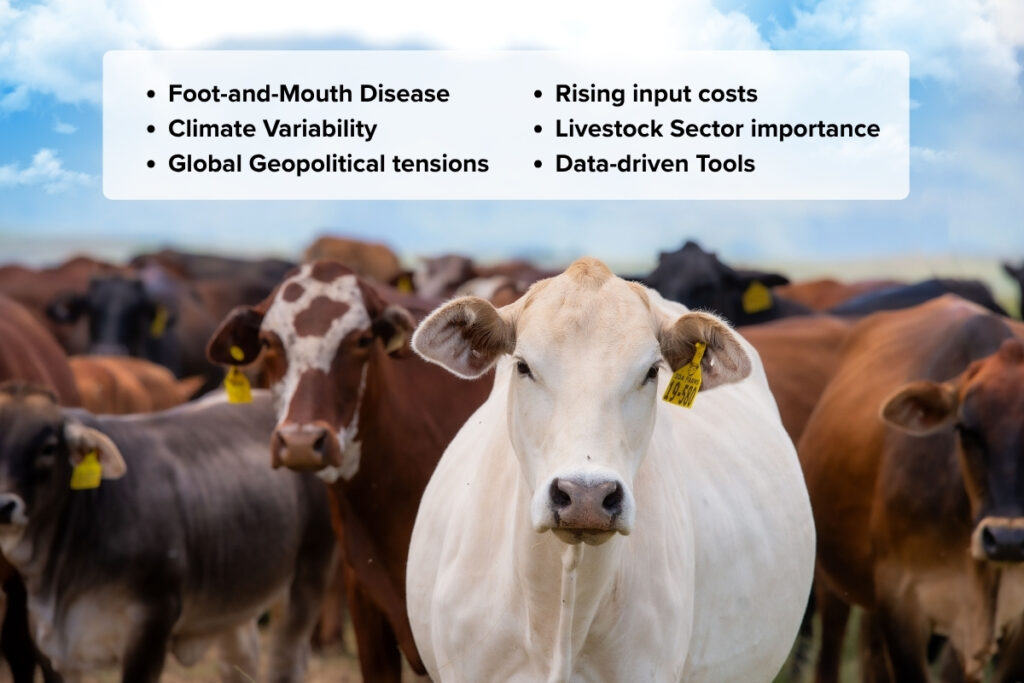
South Africa’s livestock farming industry remains a cornerstone of the agricultural economy, particularly in areas where cropping is not viable. Yet, for many livestock farm producers, the operating environment has become noticeably tougher in recent years. Disease outbreaks such as foot‑and‑mouth disease, increasing climate variability, global geopolitical tensions and rising input costs are all placing pressure on farm profitability. Many of these challenges are outside a farmer’s direct control, but their impact is felt very clearly at farm level – through higher costs, disrupted markets and increased uncertainty around long‑term planning.
In response, more producers are turning their attention to the areas they can control. Data‑driven tools such as benchmarking are increasingly being used to understand how a business is performing relative to similar farms, and where practical improvements can be made. In an environment where margins are tight and risk is elevated, focusing on efficiency, productivity and informed decision‑making is becoming essential for building resilience in livestock farming businesses.
The importance of the livestock sector
Livestock farming plays a major role in South Africa’s agricultural economy, especially in regions where cropping simply isn’t an option. Large parts of the country are better suited to grazing, and livestock turn natural veld into real value product such as beef, milk, wool and income for thousands of farming families. In many rural communities, livestock farming isn’t just another sector – it’s the main economic driver that keeps people employed and local businesses moving.
| Livestock type | Estimated population |
| Cattle | ~12 million |
| Sheep | ~21 million |
| Goats | ~5 million |
These numbers highlight the scale of the industry. Millions of cattle, sheep and goats help feed the nation, support local processors and create opportunities all along the value chain – from farmworkers and feed suppliers to transporters and auctioneers.
Despite its importance, livestock production is increasingly exposed to a range of external pressures that farmers cannot easily control. Disease outbreaks, climate variability, global market disruptions and rising input costs all influence farm performance and profitability. These factors create uncertainty for producers and make long-term planning more difficult. However, while many of these pressures cannot be controlled, farmers can improve how efficiently their businesses operate.
FMD and biosecurity – the biggest immediate risk
Disease outbreaks remain one of the most significant risks facing livestock farming producers. In South Africa, foot‑and‑mouth disease (FMD) has become the most pressing biosecurity challenge in recent years. The resurgence of FMD has had direct consequences for both farm‑level production and access to key export markets.
While FMD does not typically result in high mortality in adult animals, its impact is felt through reduced productivity – including lower milk yields, weight loss and reproductive setbacks. For many producers the biggest risk lies beyond the farm gate. FMD outbreaks trigger immediate trade restrictions, limiting access to export markets and placing downward pressure on livestock prices across the value chain. With outbreaks now reported across all provinces, the scale of the challenge has increased significantly.
| Indicator | Impact |
| Beef export decline | ~ 25% drop in 2025 |
| Beef exports to China | ~ 70% decrease |
| Estimated annual export loss | ~ R5.5 billion |
| Dairy losses per affected cow | ~ R5 000 |
These disruptions extend well beyond individual farms. Reduced export volumes, particularly to major markets such as China, have contributed to revenue losses across the red‑meat and dairy industries. Resulting in more uncertainty for producers, processors and exporters, making long‑term planning more difficult at every level of the supply chain.

South Africa has strengthened its response by adopting a vaccination‑focused strategy to control outbreaks and work toward regaining disease‑free status. Alongside vaccination, improvements in traceability, animal‑movement control and every day on farm biosecurity are becoming increasingly important. For livestock farming producers, maintaining strong biosecurity is no longer optional – it is essential for managing production risk and protecting access to key markets.
Climate and environmental pressure
Climate remains one of the biggest uncertainties in livestock farming. Rainfall in South Africa has always been irregular, and when conditions change, farmers feel it immediately. A dry spell means reduced grazing, more pressure on camps and higher feed costs. Even in favourable seasons, conditions can shift quickly, making forward planning challenging.
Large‑scale climate patterns like El Niño and La Niña add another layer of uncertainty. La Niña usually brings better rain for summer‑rainfall areas – something many farmers benefited from in the 2025-2026 season. But these cycles don’t last. As La Niña fades, conditions return to normal, and the coming winter is expected to be drier. Recent reports indicate early signs are pointing to a possible El Niño developing for the 2026-2027 season, which could mean below‑average rainfall and tighter grazing pressure.
For livestock farming operations, this all comes down to flexibility. As veld conditions shift, management must adapt. Stocking decisions, grazing rotations, feed planning and water availability all become critical levers. And because no farmer can control the weather, knowing your numbers and understanding what’s realistic for your environment, becomes one of the best tools for staying ahead of climate pressure.
Rising production costs
Rising input costs have become one of the biggest pressure points for livestock farmers. Feed, fuel, transport, labour and veterinary expenses have all increased in recent years, tightening margins across different production systems. For extensive operations, where profitability relies on efficient land use and careful grazing management, these cost increases are particularly challenging.
Global uncertainty is also contributing to rising production costs. Ongoing instability in the Middle East has raised concerns about disruptions to global energy and fertiliser supply. This has major effects on farm production as diesel drives almost every part of a farming operation – from transport and water pumps to daily fieldwork. When fuel and oil prices rise, both production and logistics become more expensive.
Fertiliser is another major pressure point, as South Africa imports the bulk of what it needs, which means local prices rise quickly when the global market is unstable. Fertiliser can make up a large share of production costs for crop farmers, and when those prices rise, grain and feed production become more expensive – ultimately increasing feed costs for livestock producers.
With so many of these challenges outside a farmer’s control, producers are becoming more and more focused on the areas they can influence. This is where benchmarking becomes extremely valuable, as it shows whether your cost structure is in line with comparable farms, where improvements can be made and where you can cut back to protect profitability.
Why benchmarking matters more in tough years
Benchmarking has become an essential tool for livestock farmers, especially when margins are tight and conditions are unpredictable. Rather than relying on assumptions, benchmarking gives a clear, data‑driven view of how your operation performs compared with farms in similar environments. It highlights strengths, identifies inefficiencies and points to areas where practical improvements can make a real difference.
| Indicator | Purpose |
| Stocking rate (ha/LSU) | Measures grazing pressure and land utilization |
| Production per hectare | Indicates land productivity |
| Reproductive performance | Measures herd or flock efficiency |
| Cost of production | Determines financial sustainability |
A recent benchmarking project in the Eastern Cape showed just how much performance can differ between farms operating under similar climate conditions. Stocking rates, grazing practices, reproductive performance and overall production varied widely. These differences had a direct impact on profitability. The results underline a key point – even when farmers face the same external pressures, management decisions still play a major role in determining outcomes.

This is why benchmarking becomes even more valuable in challenging years. When rising costs, disease risks or climate stress create uncertainty, knowing your numbers helps ground decision‑making. Benchmarking allows farmers to focus on the aspects they can control, such as reproductive efficiency, grazing pressure, cost management and land use, to make informed choices that strengthen long‑term resilience.
Positive outlook for the industry
Despite the challenges, there are strong reasons to remain optimistic about the future of South Africa’s livestock sector. Global demand for animal protein continues to rise, and once the country improves disease control and rebuilds market confidence, export opportunities are expected to grow again.
The wider agricultural sector has also delivered solid results in recent years. Good rainfall has supported strong crop production and improved veld conditions, providing relief for many livestock farmers. Strong export performance in field crops and horticulture has helped stabilise agriculture overall.
Progress in biosecurity is another positive development. Improved vaccination strategies, better traceability and stricter movement control are expected to reduce the long‑term impact of diseases like FMD. At farm level, improved access to data tools is helping producers make more confident decisions around grazing, herd performance and long‑term planning.
While climate variability and rising costs remain ongoing challenges, South African farmers have a long history of adapting to tough conditions. With stronger management practices, improved biosecurity and smarter use of information, the livestock sector is well‑positioned to stay resilient and competitive in the years ahead. So, if you would like to ensure your farm stays resilient with stronger management practices, take the next and contact us:
Visit our website or contact info@pinionza.com for more information.