March 2026

Pinion SA Blogs and Business Insights | Stay Compliant: Everything Employers Need to Know About the New Physical Agents Regulations
Uncategorized

Stay Compliant: Everything Employers Need to Know About the New Physical Agents Regulations

Understanding the New Physical Agents Regulations: What Employers Need to Know The Physical Agents Regulations, which came into effect on 6 March 2025, is set to replace the Environmental Regulations for Workplaces after an 18‑month transition period. These new regulations modernise how workplaces identify, measure, and control exposure to various physical agents that could cause injury or illness. Below is a practical, easy‑to‑digest summary of what the new legislation requires and how businesses can prepare. What Are Physical Agents? A physical agent is any energy source that may harm employees through exposure. The new Regulations outline several key occupational stressors: Indoor air quality is included because it is directly influenced by physical energy sources such as ventilation, heating, cooling, filtration, and airflow systems. A Programme-Based Approach A major shift in the new Regulations is the requirement for a Physical Agents programme-based approach—a structured, ongoing process integrated into an organisation’s existing occupational health and safety management system. This programme must: 1. Anticipating Exposure Competent Person Requirements Exposure monitoring must be performed by a competent person—as defined in the Regulations—who has: This person must be registered as an Approved Inspection Authority (AIA) with the Department of Employment and Labour and may or may not be the same person who conducted the exposure risk assessment. Monitoring Equipment All equipment used to monitor physical agents must: 2. Identifying Hazards: Conducting an Exposure Risk Assessment The employer is responsible for ensuring the workplace remains healthy and safe. A thorough exposure risk assessment must include: Steps in the assessment: When should assessments be reviewed? At least every two years, or sooner if: 3. Analysing Exposure Results Once monitoring is complete, the findings must be evaluated. Employers should: When is exposure a problem? When it exceeds Occupational Exposure Limits (OELs). The Regulations (see link below) include detailed tables—here are the key limits: Thermal Stress (table 1) Illumination (table 4) Indoor Air Quality (table 3) Vibration (table 1) Non‑ionising Radiation (table 1) Electromagnetic fields 4. Controlling Exposure to Physical Agents Once risks are identified, the employer must implement controls. The action plan should address: Final Thoughts The Physical Agents Regulations bring significant changes, emphasising proactive, integrated risk management. By developing a comprehensive Physical Agents programme and ensuring all competency, monitoring, and control requirements are met, employers can protect their workforce and comply with the new legislation. Click here to read the full OHS Act, 1993 (Act no. 85 of 1993) Physical Agents Regulations and view all tables referred to above. For more information, visit our website or contact ohs@pinionza.com.

Pinion SA Blogs and Business Insights | Livestock Farming in South Africa: Current Pressures and the Promising Path Ahead
Uncategorized

Livestock Farming in South Africa: Current Pressures and the Promising Path Ahead

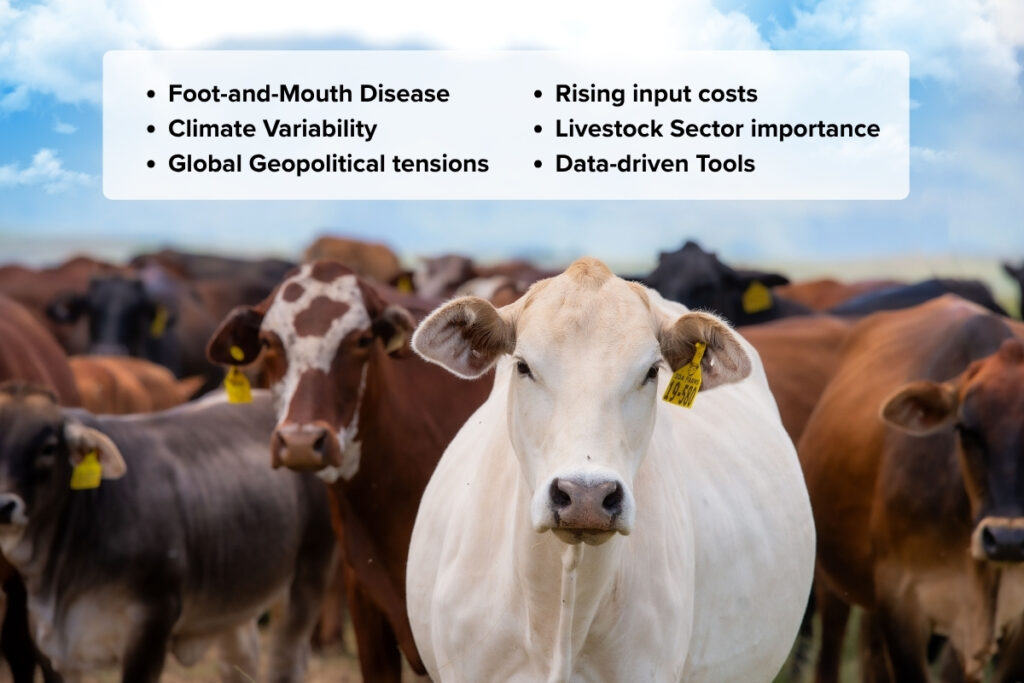
South Africa’s livestock farming industry remains a cornerstone of the agricultural economy, particularly in areas where cropping is not viable. Yet, for many livestock farm producers, the operating environment has become noticeably tougher in recent years. Disease outbreaks such as foot‑and‑mouth disease, increasing climate variability, global geopolitical tensions and rising input costs are all placing pressure on farm profitability. Many of these challenges are outside a farmer’s direct control, but their impact is felt very clearly at farm level – through higher costs, disrupted markets and increased uncertainty around long‑term planning. In response, more producers are turning their attention to the areas they can control. Data‑driven tools such as benchmarking are increasingly being used to understand how a business is performing relative to similar farms, and where practical improvements can be made. In an environment where margins are tight and risk is elevated, focusing on efficiency, productivity and informed decision‑making is becoming essential for building resilience in livestock farming businesses. The importance of the livestock sector Livestock farming plays a major role in South Africa’s agricultural economy, especially in regions where cropping simply isn’t an option. Large parts of the country are better suited to grazing, and livestock turn natural veld into real value product such as beef, milk, wool and income for thousands of farming families. In many rural communities, livestock farming isn’t just another sector – it’s the main economic driver that keeps people employed and local businesses moving. Livestock type Estimated population Cattle ~12 million Sheep ~21 million Goats ~5 million Table 1: Estimated livestock numbers in South Africa These numbers highlight the scale of the industry. Millions of cattle, sheep and goats help feed the nation, support local processors and create opportunities all along the value chain – from farmworkers and feed suppliers to transporters and auctioneers. Despite its importance, livestock production is increasingly exposed to a range of external pressures that farmers cannot easily control. Disease outbreaks, climate variability, global market disruptions and rising input costs all influence farm performance and profitability. These factors create uncertainty for producers and make long-term planning more difficult. However, while many of these pressures cannot be controlled, farmers can improve how efficiently their businesses operate. FMD and biosecurity – the biggest immediate risk Disease outbreaks remain one of the most significant risks facing livestock farming producers. In South Africa, foot‑and‑mouth disease (FMD) has become the most pressing biosecurity challenge in recent years. The resurgence of FMD has had direct consequences for both farm‑level production and access to key export markets. While FMD does not typically result in high mortality in adult animals, its impact is felt through reduced productivity – including lower milk yields, weight loss and reproductive setbacks. For many producers the biggest risk lies beyond the farm gate. FMD outbreaks trigger immediate trade restrictions, limiting access to export markets and placing downward pressure on livestock prices across the value chain. With outbreaks now reported across all provinces, the scale of the challenge has increased significantly. Indicator Impact Beef export decline ~ 25% drop in 2025 Beef exports to China ~ 70% decrease Estimated annual export loss ~ R5.5 billion Dairy losses per affected cow ~ R5 000 Table 2: Economic impact of FMD on South Africa’s livestock industry These disruptions extend well beyond individual farms. Reduced export volumes, particularly to major markets such as China, have contributed to revenue losses across the red‑meat and dairy industries. Resulting in more uncertainty for producers, processors and exporters, making long‑term planning more difficult at every level of the supply chain. South Africa has strengthened its response by adopting a vaccination‑focused strategy to control outbreaks and work toward regaining disease‑free status. Alongside vaccination, improvements in traceability, animal‑movement control and every day on farm biosecurity are becoming increasingly important. For livestock farming producers, maintaining strong biosecurity is no longer optional – it is essential for managing production risk and protecting access to key markets. Climate and environmental pressure Climate remains one of the biggest uncertainties in livestock farming. Rainfall in South Africa has always been irregular, and when conditions change, farmers feel it immediately. A dry spell means reduced grazing, more pressure on camps and higher feed costs. Even in favourable seasons, conditions can shift quickly, making forward planning challenging. Large‑scale climate patterns like El Niño and La Niña add another layer of uncertainty. La Niña usually brings better rain for summer‑rainfall areas – something many farmers benefited from in the 2025-2026 season. But these cycles don’t last. As La Niña fades, conditions return to normal, and the coming winter is expected to be drier. Recent reports indicate early signs are pointing to a possible El Niño developing for the 2026-2027 season, which could mean below‑average rainfall and tighter grazing pressure. For livestock farming operations, this all comes down to flexibility. As veld conditions shift, management must adapt. Stocking decisions, grazing rotations, feed planning and water availability all become critical levers. And because no farmer can control the weather, knowing your numbers and understanding what’s realistic for your environment, becomes one of the best tools for staying ahead of climate pressure. Rising production costs Rising input costs have become one of the biggest pressure points for livestock farmers. Feed, fuel, transport, labour and veterinary expenses have all increased in recent years, tightening margins across different production systems. For extensive operations, where profitability relies on efficient land use and careful grazing management, these cost increases are particularly challenging. Global uncertainty is also contributing to rising production costs. Ongoing instability in the Middle East has raised concerns about disruptions to global energy and fertiliser supply. This has major effects on farm production as diesel drives almost every part of a farming operation – from transport and water pumps to daily fieldwork. When fuel and oil prices rise, both production and logistics become more expensive. Fertiliser is another major pressure point, as South Africa imports the bulk of what it needs, which means local prices rise quickly when the global market is unstable. Fertiliser

Pinion SA Blogs and Business Insights | Why Occupational Health and Safety Matters: Leveraging the OHS Act and Regulations for a Productive Workplace
Uncategorized

Why Occupational Health and Safety Matters: Leveraging the OHS Act and Regulations for a Productive Workplace

Encouraging Employer Compliance with the Occupational Health and Safety Act 85 of 1993. Compliance with the Occupational Health and Safety Act 85 of 1993 (OHS Act) is often seen as a legislative obligation. However, when applied effectively, the Act and its regulations enhance operational efficiency, reduce losses, and strengthen employee performance. By viewing regulatory requirements as practical management tools, employers can meet legal duties while supporting — and often improving — overall productivity. Employer Duties in Practice: Section 8 of the OHS Act Section 8 requires employers to take reasonably practicable steps to ensure a working environment that is safe and without risk to health. 1. Hazard Identification and Risk Mitigation — Section 8(2)(a) Examples: 2. Information, Instruction, Training & Supervision — Section 8(2)(e) Examples: Incident Reporting: Sections 24 & 25 of the OHS Act Employers must report and investigate incidents and near misses. Reportable incidents must be submitted to the Compensation Commissioner within 7 days. Productivity benefit:Investigations identify root causes and reinforce preventative measures. Learning from near misses reduces the likelihood of major incidents and production disruptions. General Safety Regulations: Foundations for Daily Compliance These universal regulations are often the most practical entry point for influencing compliance. Hazardous Chemical Agents Regulations: Protecting Health and Supporting Efficiency Employers must: Productivity advantage:Improved handling reduces spills, corrosion, illness, and equipment damage — all of which impact production efficiency. Noise-Induced Hearing Loss Regulations: Preserving Long-Term Workforce Capacity Employers must: Benefit:Prevention reduces compensation claims and preserves the skills and capacity of experienced workers. Driven Machinery Regulations: Preventing High-Impact Incidents Requirements include: Operational benefit:Compliance prevents serious incidents that lead to prolonged shutdowns, investigations, and costly repairs. Construction Regulations: Planning for Safe, Efficient Project Delivery These regulations require: Productivity impact:Effective planning reduces delays, prevents stoppages, and improves coordination, resulting in smoother project execution. Role of Health and Safety Representatives and Committees Sections 17–20 require the appointment of representatives and committees where applicable. Practical benefits: Employer advantage:Demonstrating proactive compliance reduces enforcement pressure from authorities. Consequences of Non-Compliance: Enforcement Mechanisms The OHS Act provides several enforcement tools: A single prohibition notice can halt production entirely, underscoring the financial importance of proactive compliance. Building a Culture of Continuous Improvement Sustainable compliance depends on active workforce participation. Key strategies: This approach aligns legal compliance with operational excellence, creating a resilient and productive organisation. Compliance with the OHS Act 85 of 1993 is not merely a legal requirement — it is a strategic advantage. By integrating regulations into daily operations, employers create safer, more efficient, and more profitable workplaces. Prevention reduces disruptions, liabilities, and costs, transforming compliance into a business asset rather than an obligation. For more information, visit our website or contact ohs@pinionza.com.

Scroll to Top